


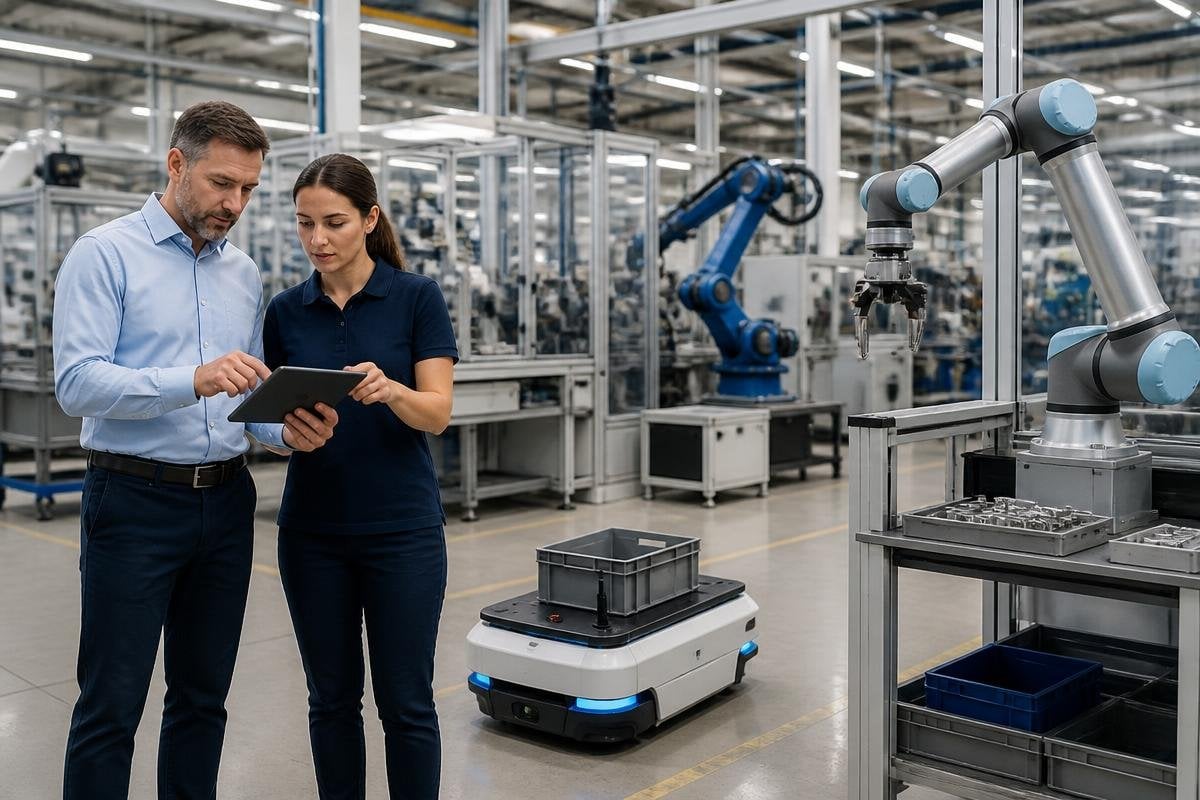
A factory deciding its next automation project has more choices than a robot arm on a workbench. The useful question is which technology fixes a real production task, fits the plant, and gives operators a clear way to check the result.
- Machine vision checks parts, surfaces, and positions before the next process
- Mobile robots move materials between work areas
- Digital models test layout and control changes before work starts
Machine vision for inspection and guidance
Machine vision gives a robot a way to read objects through cameras and software. It can check a part for a missing feature, find its position on a conveyor, or guide a gripper toward an item that does not arrive in the same place every time.
That matters when manual inspection slows production or misses small defects. A camera system also creates a record of each check, though that record only helps if the lighting, camera position, and pass-fail rules stay under control.
Manufacturers should ask for sample results from their own parts. A system that works on clean test pieces may struggle with glare, oil, dust, or changes in surface color. The test should include the worst parts the line is expected to handle.
Mobile robots for material movement
Autonomous mobile robots move bins, parts, or finished goods through a plant. They use sensors and maps to choose a route, stop for people, and reach a marked work area without a fixed track.
The practical gain comes from removing repeated walking and forklift trips from a worker’s shift. It also gives production teams a way to change routes through software when machines or storage areas move.
The limits are just as plain. Doors, narrow aisles, mixed traffic, uneven floors, and blocked routes can turn a short trip into a delay. A plant needs floor markings, safe crossing rules, charging space, and a plan for manual recovery when a robot stops.
Those floor limits also matter when a robot shares a station with people. Robot24.com’s factory robot reporting adds dated deployment details and test results to supplier claims, giving manufacturers a clearer basis for choosing the next system.
Collaborative robots and flexible work cells
Collaborative robots work near people under defined safety conditions. They can handle tasks such as loading a machine, moving parts between stations, or placing items into fixtures.
Their value rises when a manufacturer runs several products in small batches. A robot arm that can be moved and taught for a new task may fit that work better than a fixed line built for one product.
Safety still needs a real site review. The robot, tool, part, speed, force, and nearby equipment all affect the risk. A supplier demonstration cannot replace a check of the finished cell, including the actions an operator takes when a part jams.
Digital twins and robot software
A digital twin is a computer model of a machine, cell, or plant. Engineers can use one to test reach, timing, traffic, and layout before they move hardware.
The model helps when a change could stop production. It can show that a robot’s reach is too short, that two mobile robots meet in one aisle, or that a new cycle leaves no time for a worker to load the fixture.
The model remains useful only when its data matches the plant. Old layouts, missing machine limits, or wrong cycle times can produce a clean simulation and a poor result on the floor.
Treat the model as a test bench, not a substitute for checking the equipment.
A buying check for the plant floor
Before choosing a system, write down the task and check these points:
- Task: name the part, motion, inspection, or trip the robot must handle
- Input: record changes in size, position, lighting, packaging, and floor traffic
- Safety: define stops, handoffs, recovery steps, and access zones
- People: assign who loads parts, clears faults, and checks results
- Proof: run a site test with real parts and the planned work rate
- Cost: include tools, software, training, service, power, and floor changes
The best technology to watch is the one tied to a measurable plant problem. I’d start with the task that repeats often, has clear pass-fail results, and can be tested without putting the whole line at risk. The next step is a small trial with real parts, real operators, and a written result.
