


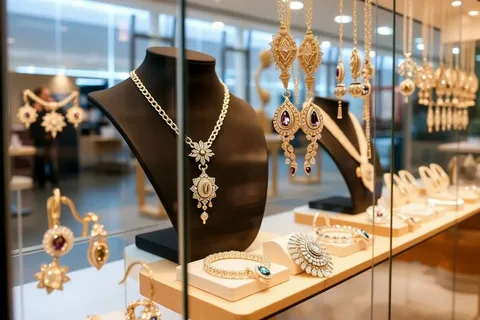
The notion of personalised production at scale could seem paradoxical at first glance. When you think of custom items you usually think about short runs and specific artistry. Wholesale manufacturing is linked to standardised methods and huge volume output.
However, the two methods may be combined in the hands of a qualified maker that employs good planning, contemporary manufacturing methods, skilful workmanship, and rigorous quality control.
This Jewelry Manufacturers in USA equilibrium may provide huge prospects for modern jewellery enterprises. A company may also take use of wholesale manufacturing capabilities to produce distinctive pieces, create coordinated collections, explore new styles and provide items tailored to its unique clients.
Materials and Finishes That Define Signature Collections
The design of a jewellery item is just part of its individuality. Materials, colours, textures, jewels and finishes may radically modify its look and impact how the buyer perceives the item.
Custom jewellery manufacture allows businesses more control over these factors. Rather of being restricted to the materials and finishes available in conventional collections, companies may explore combinations that are more in keeping with their creative vision.
Material choices may impact everything from the visual appearance of a piece to its weight and general feel. varied materials provide varied degrees of sheen, texture, colour and visual depth. The correct alternative is chosen based on trade-off between aesthetic and practical production needs.
Finishing too may be revolutionary. A polished surface will provide a sleek and elegant look while matte, brushed, textured or hammered treatments may provide a modern or handmade impression. Contrast may also be created by combining many finishes within one design.
This partnership is of particular importance if the firm is planning a wholesale purchase. What works as a one-off may need some tweaking before it can be made hundreds or thousands of times. The design has to be functional enough to be repetition manufactured but yet keep the features that make it identifiable.
Modern technologies can help with this. Digital modelling and other manufacturing technologies may assist to visualise dimensions, develop forms and provide exact requirements. These techniques may help find possible issues before actual production starts.
But technology cannot substitute experience. It need practical know-how to know how a given design will perform in production. Experienced producers can see where a design could need reinforcing, where a specific finish would need special care or where certain elements might be difficult to duplicate consistently.
This blend of artistic direction and technological advancement means bespoke jewellery may break free from the confines of ordinary mass manufacture. The brand controls the design and the producer finds a practical way of manufacturing it in scale.
Combining Craft with Modern Manufacturing
The custom jewellery manufacture has been defined as a hybrid of traditional artistry and contemporary manufacturing techniques. Both are vital in the creation of unique jewellery in bulk amounts.
Craftsmanship brings the human insight needed to read complex designs. Different materials and components are handled by skilled craftsmen focused on shape, assembling, detailing, polishing, setting and finishing. Their knowledge helps them to tackle designs that may demand more accuracy than typical items.
Whereas modern production procedures may help ensure uniformity and efficiency. Depending on the product, manufacturers may utilise digital design tools, specialised equipment, moulds, precise procedures and organised manufacturing workflows. These techniques allow a design to be replicated again and again, while keeping its fundamental features.
The idea is not to pick craftsmanship or technology. It is to use them both efficiently.
A personalised jewellery item may have sprung from a very creative notion but to produce it wholesale needs a procedure that can be repeated. Modern tools may assist in developing precise specifications and trained craftsmen can assure the right character in the result.
This equilibrium is especially critical for complex jewellery. Small variations in proportions, texture, surface treatment or ornamental features may alter the look of a piece. Technical accuracy and craftsmanship work together to minimise undesirable differences.
Efficiency is equally important on the wholesale side. There are several phases of manufacturing for large orders and each step must be well coordinated. Manufacturing systems assist organise these steps and trained personnel watch for minutiae that machines or automated processes may not completely capture.
This allows bespoke jewellery producers to provide companies items that feel considered, rather than generic. The manufacturing size might be big, yet the attention to the design can be intricate.
Which provides companies with a solid middle ground. They do not have to pick between highly customised designs with low manufacturing capability and standardised wholesale jewellery with little difference. A good manufacturer can help move innovative concepts into a scalable manufacturing environment.
Maintaining Design Identity for Large Orders
One of the major problems in wholesale bespoke jewellery manufacture is consistency. If a design is manufactured in bigger quantities, every item has to have the same basic features.
It starts with the approved design. The producer and the client require the accurate knowledge of the specification of the product before the mass manufacturing. The sample or prototype may be a critical reference point, setting expectations for size, proportions, materials, finishes and other distinguishing aspects.
These standards may then be used to direct production teams through the manufacturing process. This is especially necessary for jewellery with detailed designs or many parts.
Consistency doesn’t imply that every single part has to be exactly the same in microscopic detail. Jewellery can keep the feel of skilled workmanship, and at the same time keep the general standards expected from a wholesale collection. What important is that modifications do not affect the design, function or presentation of the product.
Here quality control is vital. Completed work may be reviewed for visual and structural uniformity before preparation for delivery. Any finishing, stone placement, surface quality, dimensional or structural problems are recognised and attended properly.
Consistency in output helps provide a better consumer experience for the company. When items from the same collection are shown together, they should seem like they relate in design and finishing. This enhances the collection’s individuality and the brand behind it.
Finally
Consistency when the same design is reordered is also vital. If a personalised jewellery product is popular, it may be a long-term fixture in a brand’s catalogue. More Jewelry Manufacturers in USA production runs are needed. By setting the manufacturing criteria clearly you may assist guarantee that the original design is maintained through subsequent orders.
That’s why bespoke manufacturing is so much more than just building a one-of-a-kind object. The actual issue is to build a process that can be relied on to repeat uniqueness.
